
Pythagorean Theorem: How a² + b² = c² Really Works
The Pythagorean theorem says that in any right triangle, a² + b² = c²: the two short sides squared add up to the longest side squared. It lets you find a missing side in seconds. Below you will see what each letter means, a picture proof of why it works, four worked examples and the mistakes to avoid.
Pythagorean Theorem
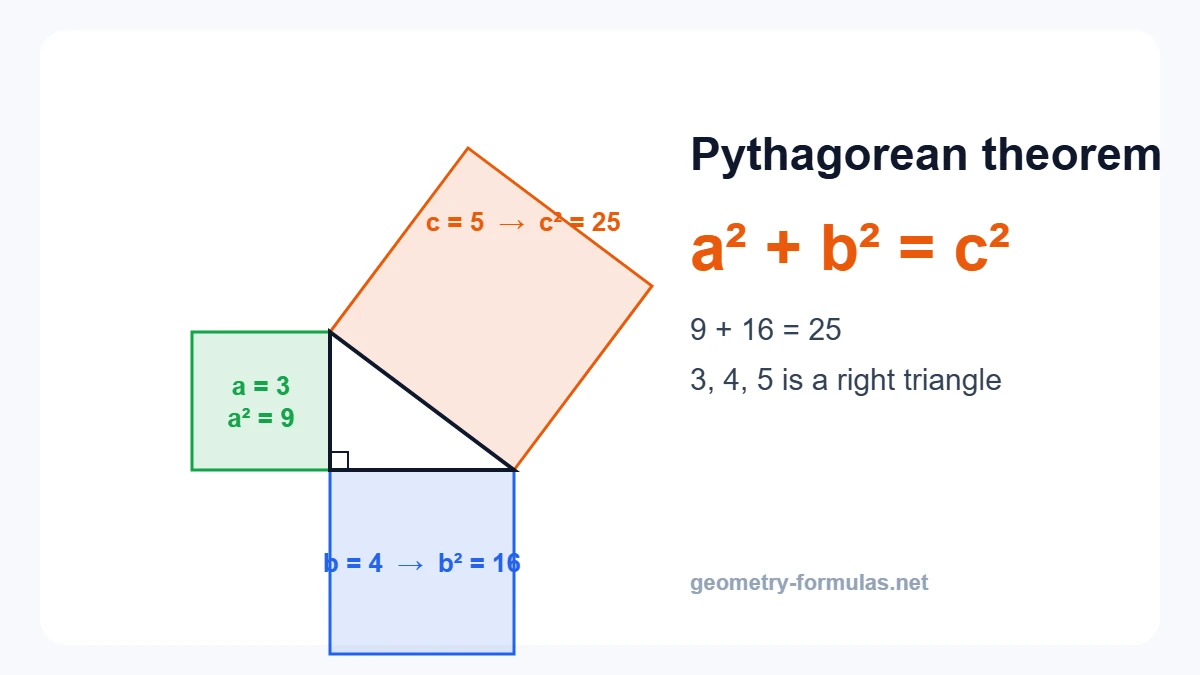
In every right triangle, the square on the hypotenuse equals the sum of the squares on the other two sides.
- Theorem
- a2 + b2 = c2
- Hypotenuse
- c = √(a2 + b2)
- Missing leg
- a = √(c2 − b2)
- a, b legs
- c hypotenuse
In this guide
What a, b and c mean
- a and b are the two legs: the sides that meet at the right angle (90°).
- c is the hypotenuse: the longest side, opposite the right angle.
- The theorem only works for right triangles. For other triangles you need the law of cosines.
Two versions you will use all the time:
- Finding the hypotenuse: c = √(a² + b²)
- Finding a leg: a = √(c² − b²)
Why a² + b² = c² really works
Draw a square on each side of a right triangle. The theorem says the two smaller squares together have exactly the same area as the big square on the hypotenuse.
Here is a simple proof. Take a large square with side length a + b and place four copies of the triangle inside it, one in each corner. The empty space left in the middle is a tilted square with side c, so its area is c². Now slide the same four triangles into two rectangles. The empty space becomes two squares: one with area a² and one with area b². The big square and the four triangles did not change, so the empty space must be the same both times: a² + b² = c².
The Pythagorean theorem is named after the Greek mathematician Pythagoras, although it was known in other cultures even earlier. For a deeper, more formal treatment with many different proofs, see Wolfram MathWorld.
Worked example 1: find the hypotenuse
A right triangle has legs of 6 cm and 8 cm. How long is the hypotenuse?
- Write the formula: c² = a² + b²
- Substitute: c² = 6² + 8²
- Square: c² = 36 + 64 = 100
- Square root: c = √100 = 10 cm
Worked example 2: find a missing leg
The hypotenuse is 13 cm and one leg is 5 cm. Find the other leg.
- Rearrange: b² = c² − a²
- Substitute: b² = 13² − 5²
- Square: b² = 169 − 25 = 144
- Square root: b = √144 = 12 cm
Worked example 3: the ladder problem
A 5 m ladder leans against a wall. Its foot is 1.5 m from the wall. How high up the wall does it reach?
- The ladder is the hypotenuse: c = 5 m. The ground is one leg: a = 1.5 m.
- b² = 5² − 1.5² = 25 − 2.25 = 22.75
- b = √22.75 = 4.77 m (to 2 decimal places)
Worked example 4: is it a right triangle?
A triangle has sides 7, 24 and 25. Is it a right triangle? This uses the converse of the Pythagorean theorem: if a² + b² equals c², the triangle has a right angle.
- Take the longest side as c: c = 25
- a² + b² = 7² + 24² = 49 + 576 = 625
- c² = 25² = 625
- They are equal, so yes, it is a right triangle.
Check your answer with the Pythagorean theorem calculator
Pythagorean triples worth remembering
Some right triangles have whole-number sides. Spotting them saves time in tests:
- 3, 4, 5 (and multiples: 6, 8, 10 · 9, 12, 15)
- 5, 12, 13
- 8, 15, 17
- 7, 24, 25
The Pythagorean theorem in real life
- Screen sizes: a 55-inch TV is measured across the diagonal. With a 16:9 screen, that is about 47.9 in wide and 27.0 in tall.
- Building: builders mark 3 m along one wall and 4 m along the other. If the diagonal is exactly 5 m, the corner is square.
- Maps and games: the straight-line distance between two points is the distance formula, which is the Pythagorean theorem on a grid.
4 common mistakes
- Using it on a triangle without a right angle. Check for the 90° mark first.
- Putting the hypotenuse in the wrong place. c is always the longest side, opposite the right angle.
- Adding when you should subtract. To find a leg, use c² − b², not c² + b².
- Forgetting the square root. c² = 100 means c = 10, not 100.
Try it yourself
A right triangle has legs of 9 cm and 12 cm. How long is the hypotenuse?
Show the answer
c² = 9² + 12² = 81 + 144 = 225, so c = √225 = 15 cm. (It is the 3-4-5 triple multiplied by 3.)
Pythagorean theorem: FAQ
What is the Pythagorean theorem?
In a right triangle, the square of the hypotenuse equals the sum of the squares of the other two sides: a² + b² = c².
Does the Pythagorean theorem work for all triangles?
No. It only works for right triangles. For other triangles, use the law of cosines: c² = a² + b² − 2ab cos C.
How do I find a missing leg?
Subtract instead of adding: a = √(c² − b²). For a hypotenuse of 13 and a leg of 5, the other leg is √(169 − 25) = 12.
What is a Pythagorean triple?
Three whole numbers that fit a² + b² = c², such as 3, 4, 5 or 5, 12, 13. Any multiple of a triple is also a triple.
All the right-triangle formulas, a calculator and a printable sheet are on the Pythagorean theorem formulas page. Yesterday’s post covered the area of a circle formula.