Area of a Parallelogram Formula: 5 Easy Worked Examples
The area of a parallelogram formula is A = b × h: base times height, exactly like a rectangle. The one trap is using the slanted side instead of the height. This guide shows why the formula works, walks through five worked examples and lists the mistakes students make most often.
In this guide
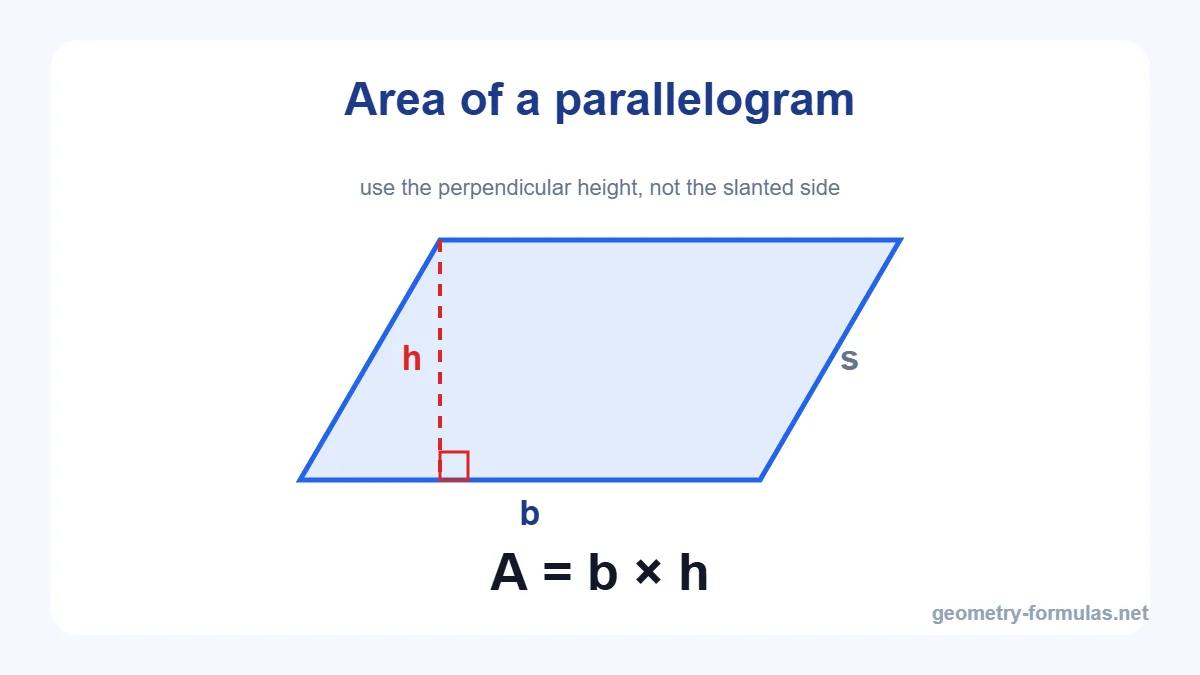
The formula and what each letter means
- A is the area, in square units such as cm² or m².
- b is the base: any side you choose to sit the shape on.
- h is the perpendicular height: the straight-up distance from the base to the opposite side.
- s is the slanted side. It is longer than h and is only used for the perimeter, P = 2(b + s).
The height always meets the base at a right angle. In diagrams it is usually drawn as a dashed line, sometimes outside the shape when the parallelogram leans a lot.
Why the area of a parallelogram is base times height
Cut a right triangle off one end of the parallelogram and slide it to the other end. The pieces now form a rectangle with the same base and the same height, and nothing was added or lost. A rectangle’s area is base × height, so the area of a parallelogram is base × height too.
This is also why a parallelogram has a smaller area than a rectangle with the same side lengths: pushing a rectangle over keeps the sides the same but lowers the height.
Worked example 1: base and height given
A parallelogram has a base of 12 cm, slanted sides of 5 cm and a height of 4 cm. Find its area and perimeter.
- Area: A = b × h = 12 × 4 = 48 cm²
- Perimeter: P = 2(12 + 5) = 34 cm
- Wrong method: 12 × 5 = 60 cm² (used the slanted side)
Worked example 2: find the height from the area
A parallelogram has an area of 54 m² and a base of 9 m. How tall is it?
- Start with A = b × h
- 54 = 9 × h
- h = 54 ÷ 9 = 6 m
Worked example 3: height from the angle
The base is 10 cm, the slanted side is 6 cm and the angle between them is 30°.
- Height: h = s × sin θ = 6 × sin 30° = 6 × 0.5 = 3 cm
- Area: A = 10 × 3 = 30 cm²
- Shortcut: A = b × s × sin θ = 10 × 6 × 0.5 = 30 cm²
You can check sine values with any scientific calculator, or read more about the sine ratio on Khan Academy’s trigonometry unit.
Worked example 4: a sloped garden bed
A flower bed is shaped like a parallelogram with a 4.5 m base and a 2 m height. One bag of mulch covers 3 m². How many bags are needed?
- Area: A = 4.5 × 2 = 9 m²
- Bags: 9 ÷ 3 = 3 bags
Worked example 5: units in a mixed problem
The base is 1.2 m and the height is 80 cm. Convert first: 80 cm = 0.8 m. Then A = 1.2 × 0.8 = 0.96 m². Multiplying 1.2 by 80 would give a meaningless 96.
Parallelogram vs. rectangle, rhombus and trapezoid
- Rectangle: a parallelogram with right angles, so the side is the height. A = l × w.
- Rhombus: a parallelogram with four equal sides. A = b × h still works, or A = (d₁ × d₂) ÷ 2 with the diagonals.
- Trapezoid: only one pair of parallel sides, so it needs the average of the two bases: A = ½(a + b) × h.
For the full set of parallelogram formulas, including diagonals and angles, see the parallelogram formulas page. For triangles, which are exactly half a parallelogram, see the area of a triangle formula.
4 common mistakes
- Multiplying the base by the slanted side instead of the height.
- Using a height that is not perpendicular to the chosen base.
- Mixing units, such as metres and centimetres, before multiplying.
- Writing the answer in cm instead of cm², or forgetting units completely.
Try it yourself
A parallelogram has a base of 9 m and a height of 3.5 m. Find its area.
Show the answer
A = 9 × 3.5 = 31.5 m²
Area of a parallelogram: FAQ
What is the formula for the area of a parallelogram?
A = b × h, where b is the base and h is the perpendicular height.
Can I use the side length instead of the height?
No. The slanted side is longer than the height, so using it gives too big an answer. Use it only for the perimeter.
How do I find the area without the height?
If you know two sides and the angle between them, use A = a × b × sin θ.
Is a square a parallelogram?
Yes. A square has two pairs of parallel sides, so the same formula works: side × side.